
Model-Driven AI Coding Tool
AI Architect Designs First, AI Programmer Codes Next | The First Tool Dedicated to “Elegant Backends”
Why conventional AI development struggles with complex backend systems
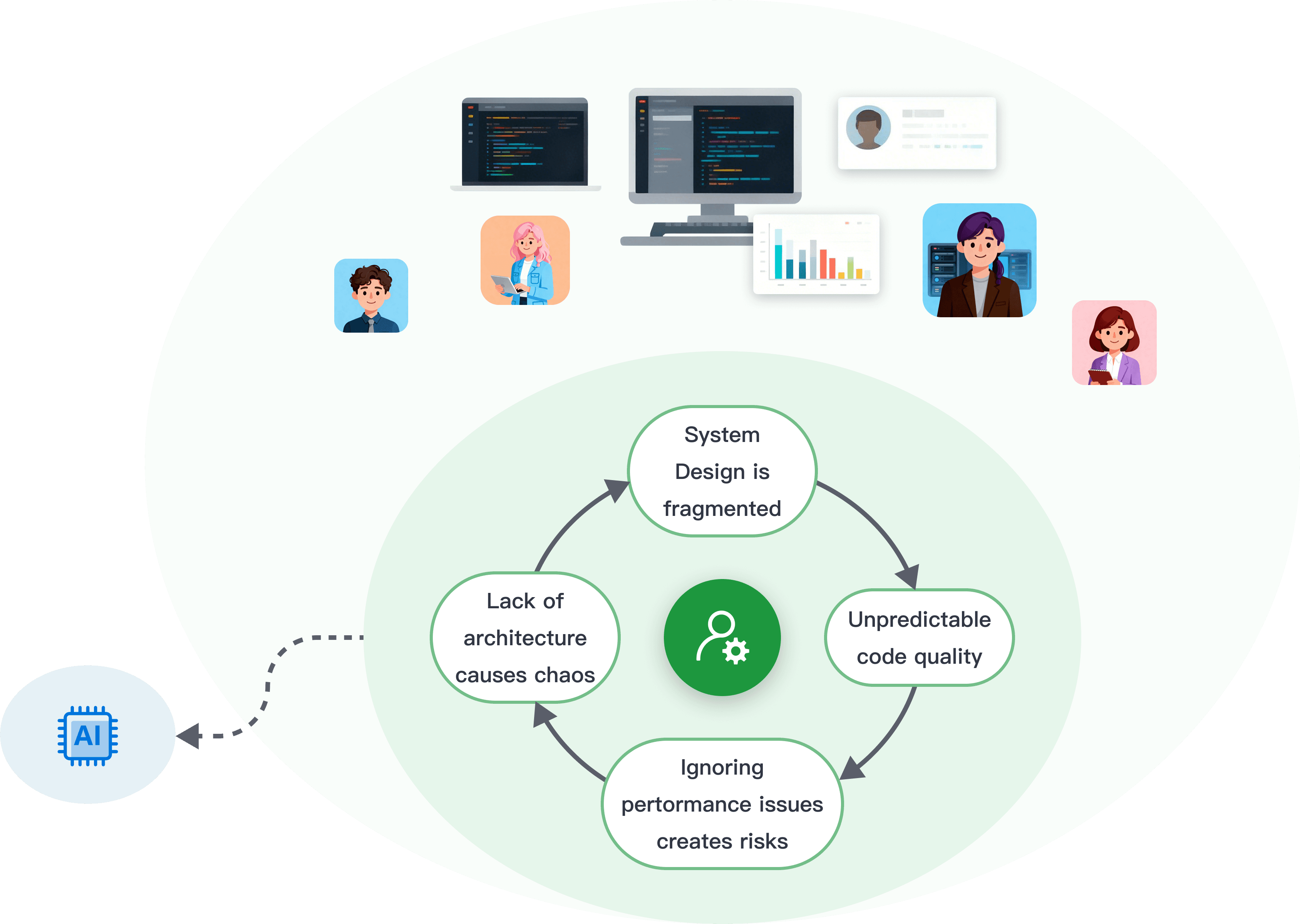
Revolutionize Waterfall with Model-Driven AI: Architecture-First Debt Management
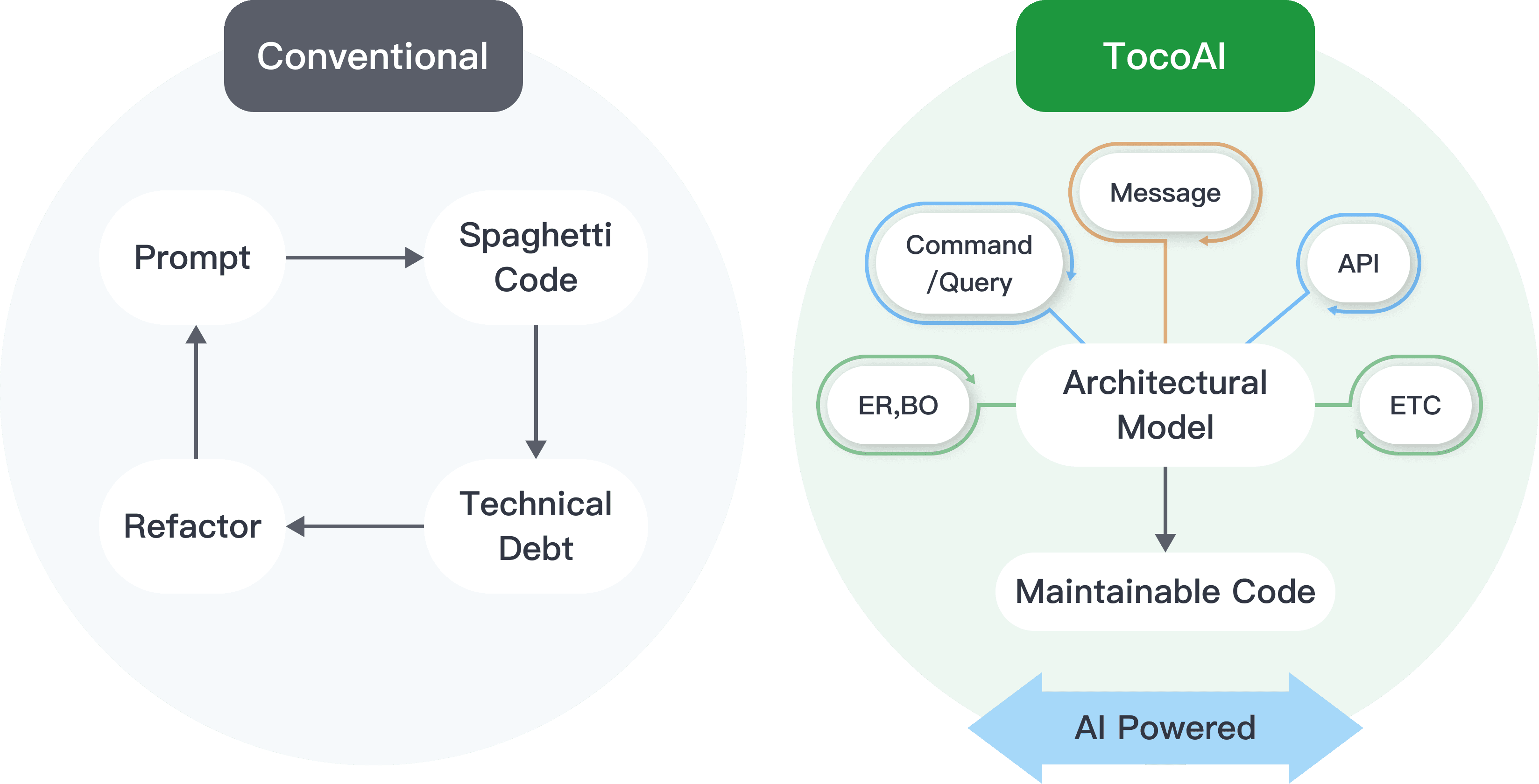
TocoAI offers a model-driven AI programming workflow based on established enterprise architecture principles.
 Domain Driven Design (DDD)
 CQRS architecture
- Layered architecture
AI + Modeling Engine, ensuring architecture-compliant, human-controllable deliverables.

Ultra-Reliable AI Architect
Architecture First. Enforce structured backend architecture from the start. Input requirements — the AI Architect constructs clean, layered models automatically. Regardless of iteration count, architecture consistency remains 100% — long-term projects stay as structured and maintainable as initial design.

Predictable Backend Code
The engine derives consistent backend framework code directly from the model. Zero guesswork, zero structural violations, zero style drift across layers. You intervene only on the remaining 20% business logic — code review effort and cost reduced by an order of magnitude.

Seamless Requirement Changes
Modify a field, relationship, or flow — model and code synchronize instantly. 99% of changes propagate without manual review.No risk of partial fixes creating cascading issues. Faster iteration cycles, stable system quality, predictable maintenance overhead.
Ultra-Reliable AI Architect
Architecture First. Enforce structured backend architecture from the start. Input requirements — the AI Architect constructs clean, layered models automatically. Regardless of iteration count, architecture consistency remains 100% — long-term projects stay as structured and maintainable as initial design.
Predictable Backend Code
The engine derives consistent backend framework code directly from the model. Zero guesswork, zero structural violations, zero style drift across layers. You intervene only on the remaining 20% business logic — code review effort and cost reduced by an order of magnitude.
Seamless Requirement Changes
Modify a field, relationship, or flow — model and code synchronize instantly. 99% of changes propagate without manual review.No risk of partial fixes creating cascading issues. Faster iteration cycles, stable system quality, predictable maintenance overhead.



Cursor / Claude Code (Conversational Coding)
TocoAI (Model-Driven Backend Development)

Auditor
Acts like an “AI Quality Inspector” — constantly fixing bugs and chasing implementation details

Controller
Acts as the “Chief Project Architect” — focused on business logic and high-level architecture
Floating Code
Looks smooth on the surface but hides subtle risks and structural issues
What You Design Is What You Get
Design = Code. Clear layering meets standards, almost never step on 'invisible logic traps'
Prompt Roulette
Success depends heavily on prompt “luck” — output randomness creates constant concern about unexpected errors
Engine-Driven Generation
Like executing from a precise blueprint — engine generates ~80% of code with clear, consistent structure
Manual Patching
Requires regenerating and re-analyzing code — high risk of breaking existing logic; maintenance grows increasingly chaotic
Automated Evolution
Modify the model → all related code updates automatically — no need to hunt for change points; easy onboarding even with team turnover
Essay-Style Review
Lengthy and verbose — extremely high cognitive load
Fill-in-the-Blank Approach
Focus only on ~20% business logic — framework code requires almost no repeated review
Personal Prompt Dependency
Output varies by individual prompting skills — inconsistent style; steep learning curve for newcomers
Unified Blueprint
Code standards enforced automatically — visual modeling reduces communication overhead and onboarding friction
One-Off Output
Generated reasoning disappears after use — limited long-term asset accumulation
Inheritable Architecture
Model serves as a “living document + source of code” — future maintenance relies on model clarity, not fragmented doc
Value of Toco for Teams

Production-Grade Efficiency Gains
Enforce architectural constraints so AI always generates reliable, production-ready code. Strict rules eliminate hallucinations and random structures for consistently trustworthy output. Fewer bugs and less rework let teams focus on real features and deliver sustained efficiency gains.

Controllable R&D Process
Ensure consistent architecture and standards across the team—no drift, no one-off hacks. Automate architecture enforcement, improving R&D management and team-wide consistency. Seamlessly handle requirement changes, architectural extensions, and refactoring—updates propagate automatically.

Inheritable R&D Assets
Transform scattered knowledge into living, shareable assets—the model becomes the team’s single source of truth. Design and architecture escape individual minds, Slack threads, and fleeting chats. Models act as visual, up-to-date design docs, speeding up onboarding for new team members.
What Our Users Say
Ethan
Back-end Developer

Noah
Back-end Developer

Alex
Independent Developer

Henry
System Architect

Isabella
Full-stack Developer

Liam
Technical Lead
Ethan
Back-end Developer
Noah
Back-end Developer
Alex
Independent Developer
Henry
System Architect
Isabella
Full-stack Developer
Liam
Technical Lead
Ethan
Back-end Developer
Noah
Back-end Developer
Alex
Independent Developer
Henry
System Architect
Isabella
Full-stack Developer
Liam
Technical Lead
Ethan
Back-end Developer
Noah
Back-end Developer
Alex
Independent Developer
Henry
System Architect
Isabella
Full-stack Developer
Liam
Technical Lead
Ethan
Back-end Developer
Noah
Back-end Developer
Alex
Independent Developer
Henry
System Architect
Isabella
Full-stack Developer
Liam
Technical Lead